Founding Director Aboriginal Arts Board of the Australia Council
"Edwards was director (1975-1980) of the AAB during a period which saw the greatest expansion of Government support for Indigenous arts ever. Many of the early projects and causes he helped initiate, champion, and support have formed the backbone of First Nations art and cultural support at Council since."
From: Jeremy Eccles. "A Significant Loss – Bob Edwards 1930-2023." Aboriginal Art Directory, 6 June 2023.
Involve and empower Indigenous voices...
"Edwards main vehicle for change, however, was the Aboriginal Arts Board of the Australian Council, set up by the Whitlam Government in 1973 to distribute funds in the field of Aboriginal arts. Edwards had lobbied for its creation and was appointed as the founding director from 1973 to 1980.
He saw his role as a means to involve and empower Indigenous voices in national life. The arts, he believed, were the key to changing attitudes towards Indigenous people and their heritage."
From: Griffiths, B. Deep Time Dreaming. Black Inc, 2018.
"Robert ('Bob') Edwards, the founding director of the AAB, was a close follower of the Papunya painting movement from the onset. As curator of anthropology at the South Australian Museum (1965-73), Edwards organised private exhibitions of Papunya paintings in Adelaide in 1972. Later, while he was director, the AAB subsidised Bardon's films and documentation projects about the painting movement at Papunya.
The Papunya painting enterprise strongly aligned with Edwards' background in cultural heritage and marketing (before becoming a heritage professional he had worked for many-years in the family fruit-growing business).
From: Berrell, N. "Inroads Offshore: The International Exhibition Program of the Aboriginal Arts Board, 1973–1980." In Experiments in Self-Determination, edited by Nicolas Peterson and Fred Myers. Monographs in Anthropology, ANU Press, 2016.
Edwards' view of self-determination drew strongly on his cultural heritage background:
'It's a pivotal thing because...to say, forget your culture because if you want to get anywhere your kids have got to be educated and the more you cling to the past the less opportunity you've got for the future.
We took another line that was if you've got your language and you've got pride in your culture you've got a confidence and you're more able to do it.'
From: Bob Edwards interview 16 November 2010.
"The Aboriginal Arts board was responsible for numerous exhibitions that toured overseas, for publications, and for the purchase of works that were given as gifts to overseas institutions in an effort to develop interest.
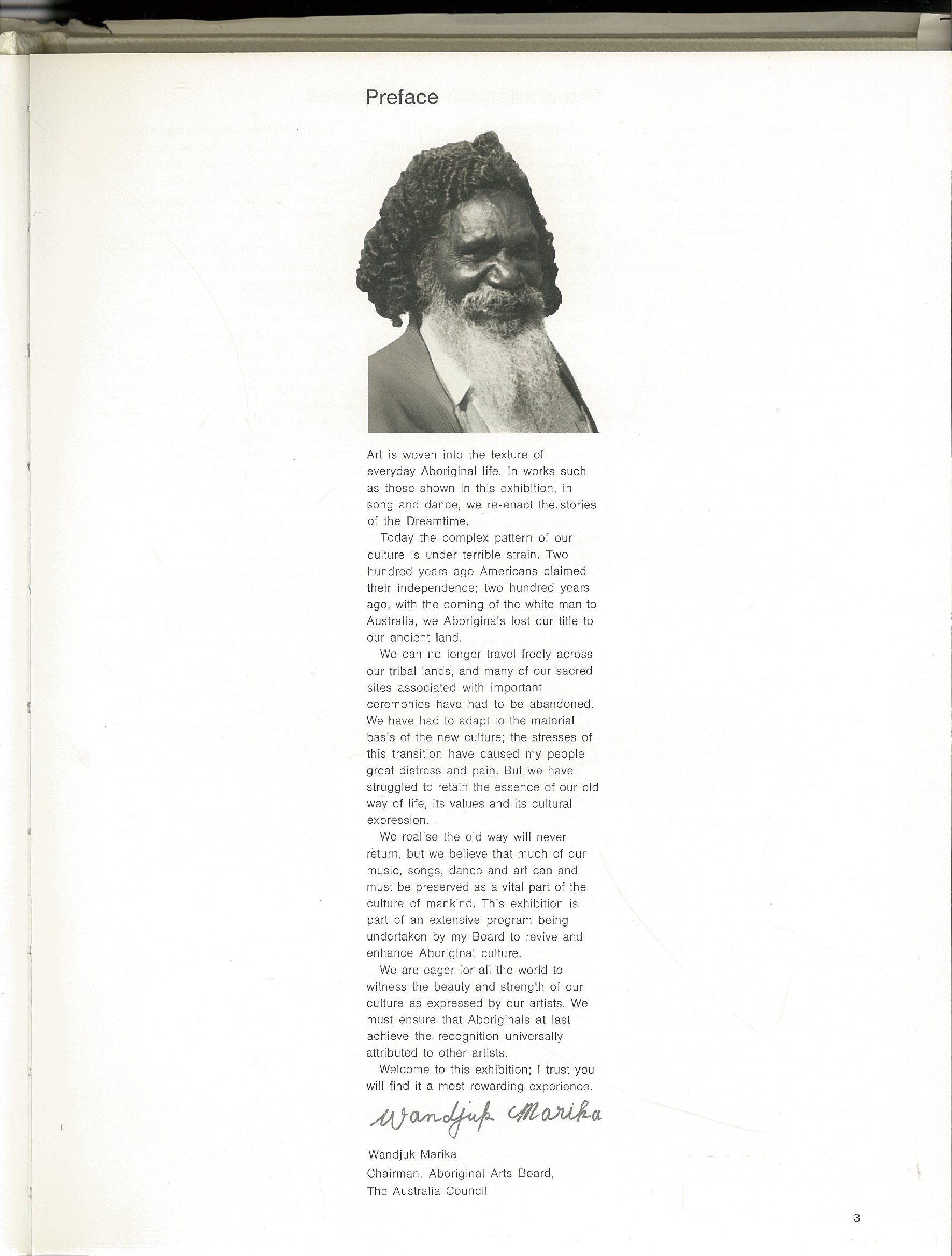
During the 1970's the work of the 15 member AAB - including its two chairmen, Dick Roughsey Goolbalathaldin (1973-75) and Wandjuk Djuskan Marika (1975-79), its non-Indigenous director Robert (Bob) Edwards (1974-80) and its project officers - increased exposure of Aboriginal art internationally through a rigorous program of exhibitions that were mounted in approximately 40 countries.
Most significantly the AAB exhibitions lifted the paintings from sheltered storerooms and offices throughout Australia and displayed them in metropolitan galleries and museums overseas.
Indigenous 'voices' were represented through the art on display, and also in person through the participation of artists and their representatives at exhibition openings and in artist exchanges. Where once Aboriginal people had been 'denied access to foreign cultural exchanges', now the board declared such exchanges to be their right.
Important artistic and political statements were now being clarified through the visual language of Australian Aboriginal art worldwide.
The extent of success of the board's activities could well be measured by its perseverance and capacity to engage a foreign audience in the face of local indifference.
From 1973 until early 1980's, at a time when the wider Australian population showed limited interest in contemporary Aboriginal and Torres Strait Islander arts the AAB organised an impressive program of art exhibitions and placed works in international collections. This firmly positioned Aboriginal art on the international stage and prepared the ground for major exhibitions such as Dreamings in New York in 1988 and the subsequent surge of both national and international interest in these works."
From: Berrell, N. "Inroads Offshore: The International Exhibition Program of the Aboriginal Arts Board, 1973–1980." In Experiments in Self-Determination, edited by Nicolas Peterson and Fred Myers. Monographs in Anthropology, ANU Press, 2016.